“Come With Me,” Said the Ex–Navy SEAL After Discovering a Widow and Her Children Abandoned on Christmas Eve — What He Did Next Changed Their Lives Forever
“Come With Me,” Said the Ex–Navy SEAL After Discovering a Widow and Her Children Abandoned on Christmas Eve — What He Did Next Changed Their Lives Forever
The snow in Oak Creek didn’t fall; it attacked. It drifted across the empty town square like shards of broken glass, glittering under the rhythmic, lonely pulse of emerald and ruby Christmas lights. On any other December 25th, the hollow whistle of the wind through the tinsel-draped oaks would have been poetic. But for Sarah Miller, it was the sound of a closing door.
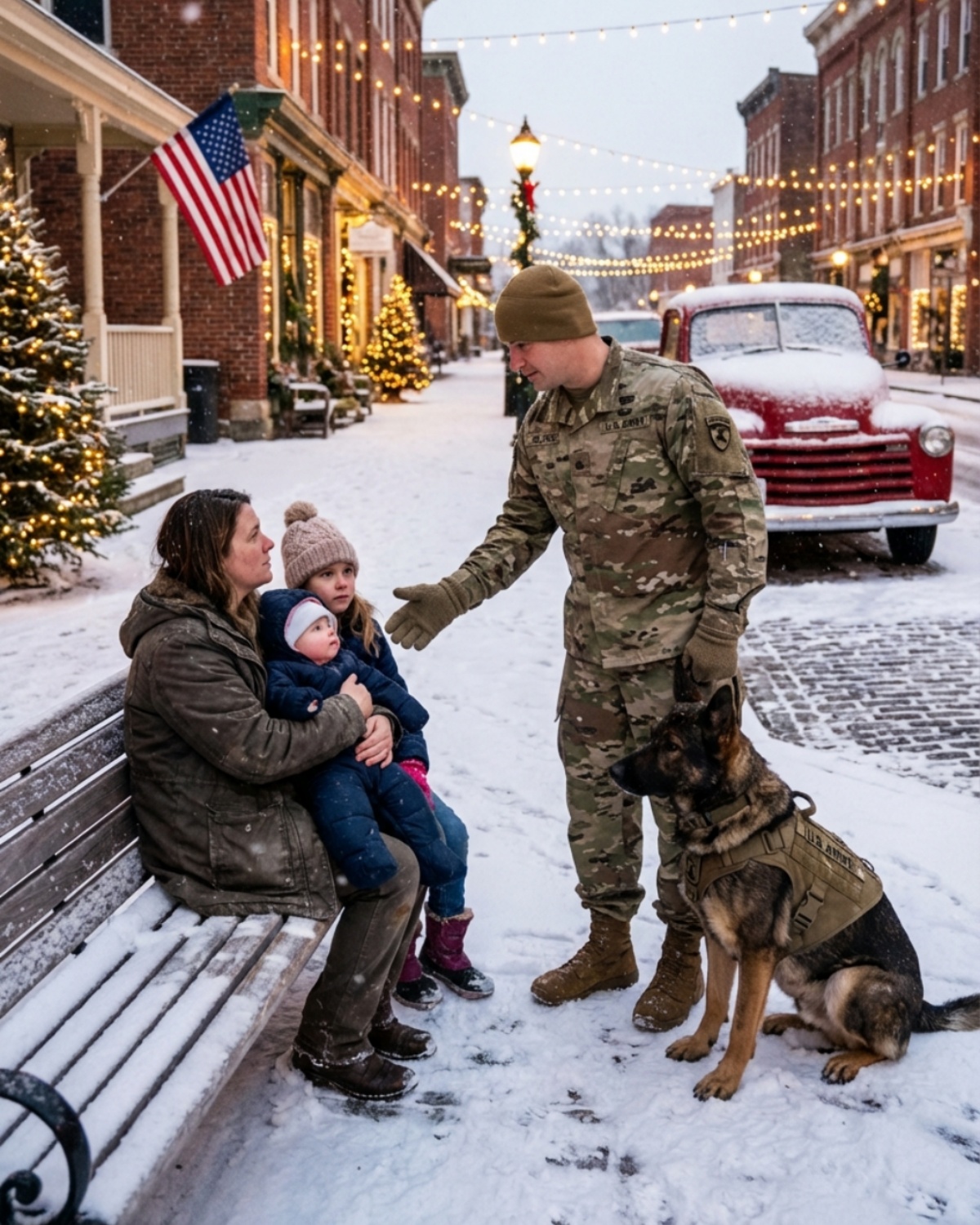
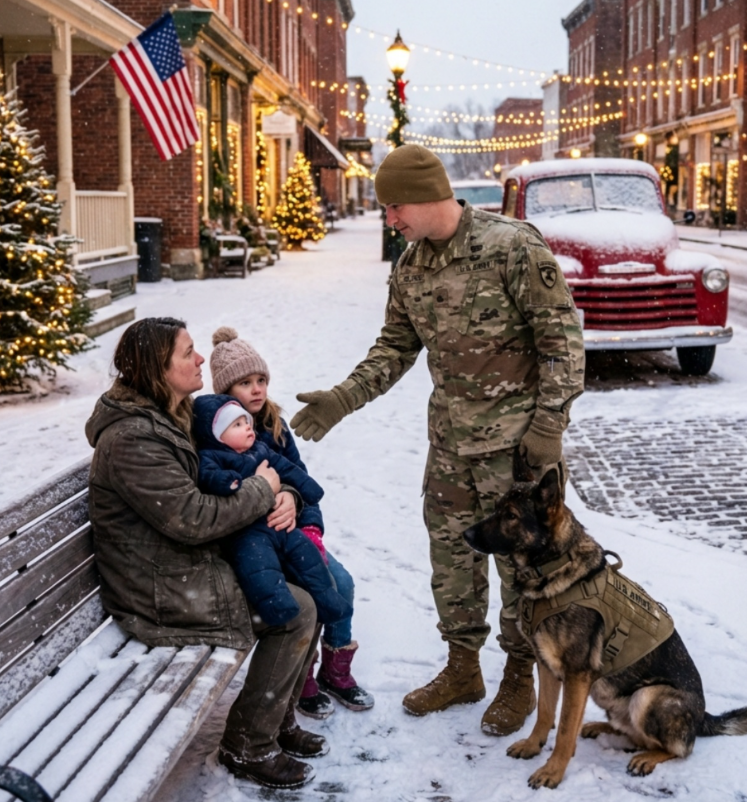
Sarah sat on a frosted iron bench, her fingers bone-white as she clutched a bundled three-month-old infant to her chest. Beside her, her two daughters—Maya, seven, and Sophie, four—were huddling against her, their small boots leaving shaky, shallow prints in the rising powder.
How Everything Fell Apart
Eight months ago, Sarah had been a wife with a mortgage, a garden, and a husband named David who smelled like sawdust and peppermint. Then came the industrial accident. Then the insurance denials. Then the predatory “late fees” from a landlord who saw a widow not as a person, but as a liability.
By 9:00 PM on Christmas night, the math was simple and cruel: Zero dollars. Zero gas in the old station wagon abandoned three miles back. Zero options.
“Mommy, is Santa lost?” Sophie whispered, her voice barely audible over the wind
Sarah swallowed the bile of failure. She didn’t have an answer. She only had a prayer, whispered into the frozen air, hoping the universe still had a crumb of mercy left for a mother who had run out of road.
The Man in the Maroon Pickup
Across the square, a pair of headlights cut through the whiteout. A maroon pickup truck idled near a flickering lamppost, its engine a low, rhythmic growl.
The door opened, and Caleb Vance stepped out.
Caleb was a man carved from granite and silence. A former Navy SEAL, he had spent twelve years operating in the shadows of the Hindu Kush and the humidity of Southeast Asia. He had returned to his hometown only a week prior, carrying the “invisible rucksack” of a man who had seen the world break in ways most people only see in nightmares.
By his side was Atlas, a Belgian Malinois whose ears were perpetually perked. Atlas wasn’t just a dog; he was Caleb’s tether to the present.
Caleb had been driving aimlessly, the holiday “cheer” of the town feeling like a foreign language he had forgotten how to speak. He saw the silhouette on the bench. He saw the way the woman’s shoulders were hunched in a defensive perimeter around her children.
He had seen that posture before—in refugee camps, in war zones, in the eyes of people who had accepted that the end was near.
The Confrontation of Kindness
Caleb approached slowly. He didn’t want to spook her. He knew that for someone in Sarah’s position, a strange man approaching in the dark was a threat, not a savior.
“Ma’am?” he called out, his voice modulated—deep, steady, but intentionally soft.
Sarah looked up. Her eyes were wide, the pupils dilated with the physiological “flight” response of the freezing. She didn’t see a veteran; she saw a giant in a navy tactical jacket. She pulled Maya and Sophie closer.
“We’re just resting,” Sarah lied, her voice cracking like thin ice. “We’re leaving soon.”
Caleb knelt. He didn’t tower over them; he brought himself down to the children’s level. Atlas sat perfectly still, sensing the fragile vibration of fear in the air.
“The temperature is dropping to five degrees tonight,” Caleb said, his breath pluming in the air. “Resting out here isn’t an option. I’m Caleb. This is Atlas. We have a warm truck and a destination. Do you?”
Sarah stared at him. She looked for the “catch.” She looked for the hidden motive. But all she saw in Caleb’s eyes was a weary, familiar understanding of struggle.
“I have nowhere,” she finally whispered, the confession breaking her. “They took the house. I just… I just needed to sit down.”
The Turning Point: “Come With Me”
Caleb felt a familiar surge of “mission focus.” This wasn’t a combat operation, but the stakes were just as high. He saw the baby’s face, pale and still. He saw the girls’ lips turning a terrifying shade of blue.
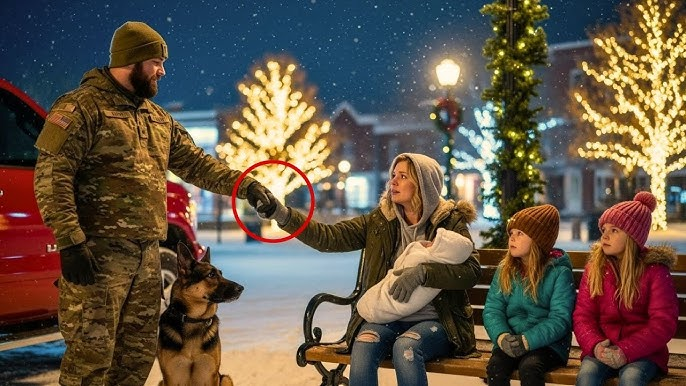
He reached out a gloved hand. It wasn’t a demand; it was an invitation.
“Come with me,” he said. Three words that carried the weight of a life raft. “No more apologies. No more sitting in the dark. My sister owns the local inn. There’s a suite with a fireplace and a kitchen that’s currently empty. It won’t be empty tonight.”
Sarah hesitated for one final, agonizing second. Then, she saw Maya look at Caleb, then at Atlas, and finally at the warm glow of the truck’s cabin.
Sarah placed her hand in Caleb’s. Her palm was a block of ice; his was a furnace.
The High-Stakes Recovery
The next two hours were a whirlwind of tactical compassion. Caleb didn’t just drop them at a hotel and leave. He went into “Logistic Support” mode.
While Sarah bathed the girls in a steaming tub at the Oak Creek Inn, Caleb was at the only 24-hour pharmacy three towns over. He returned with formula, heavy-duty winter coats, thermal blankets, and—because he was a man who understood morale—two stuffed bears and a box of high-quality chocolates.
But the real climax came three days later.
When the Past Came Knocking
Sarah’s landlord, a man named Mr. Henderson, arrived at the inn. He hadn’t come to apologize. He had come because Sarah had left a “mess” in the apartment during her eviction, and he wanted to threaten her with a small-claims suit to seize her remaining meager possessions.
Caleb was in the lobby when Henderson walked in, barking for “the Miller woman.”
Caleb didn’t raise his voice. He didn’t draw a weapon. He simply walked over to Henderson, his Navy SEAL “switch” flipping to a cold, professional setting.
“Mr. Henderson,” Caleb said, standing just a few inches too close for the man’s comfort. “I’ve spent the morning reviewing the local tenant laws. I also had a friend at the JAG office look at your ‘eviction’ notice. It seems you skipped the mandatory 30-day cure period for widows of veterans.”
Henderson scoffed. “She wasn’t a veteran. Her husband was.”
“Exactly,” Caleb’s voice dropped to a whisper that made the landlord’s neck hair stand up. “And in this town, we take care of our own. You have two choices. You can walk out of here and forget Sarah Miller exists, or we can spend the next six months in court discussing your building’s multiple fire code violations. I’ve already taken photos.”
Henderson looked at the mountain of a man in front of him, saw the unwavering discipline in his eyes, and turned on his heel without a word.
A Spring of New Beginnings
By the time the snow melted into the soft, emerald grass of April, the Miller family was unrecognizable.
Caleb had used his veteran network to help Sarah land a job as an administrator at the local VA clinic. He had helped her navigate the labyrinth of survivor benefits she didn’t even know she was entitled to.
But the healing wasn’t one-sided.
On a Saturday morning in May, Caleb stood in the yard of the small cottage Sarah was now renting. He was fixing a broken shutter, his hands moving with the same precision they once used to dismantle ordinance.
Sarah walked out with two glasses of lemonade. Maya and Sophie were chasing Atlas through a sprinkler, their laughter a sharp, beautiful contrast to the silence of that Christmas bench.
“You saved us, Caleb,” Sarah said, looking at her children.
Caleb took a sip of the lemonade, looking at the dog and the kids. For the first time in years, the “rucksack” on his back felt light.
“No, Sarah,” he replied. “I was just doing a recon of my soul. It turns out, I needed to be found just as much as you did.”
Why This Story Matters
Why This Story Matters: The SEO Perspective on Kindness
In a world filled with digital noise, stories of genuine human connection and veteran resilience remind us of the “Social Capital” that keeps communities together. Sarah and Caleb’s story isn’t just about a rescue; it’s about the reintegration of veterans through acts of local service.
Final Reflection
Sometimes, the most powerful rescues don’t happen on battlefields or in burning buildings — they happen quietly, on frozen benches, when someone chooses not to look away.
One decision. Three words. One Christmas Eve that rewrote multiple lives forever.
And in a season defined by giving, Oak Creek was reminded that kindness — real kindness — still has the power to save us all.